· 3 min read
Building μConnector: One Messaging API to Rule Them All
- open-source
- messaging
- api-design
- nodejs
Have you ever tried integrating messaging platforms like WhatsApp, Telegram, or Instagram into your app, only to find yourself stuck navigating different APIs, formats, and authentication methods for each? I have. And that experience inspired me to build μConnector, an open-source, universal messaging API mapper that simplifies the way developers connect with messaging services.
μConnector is more than just a personal project. it’s a technical response to a very real problem in today’s communication-heavy landscape. Businesses no longer rely on just one messaging channel. Customers expect real-time responses on whichever platform they prefer, and for developers, that creates a lot of unnecessary friction. With μConnector, I wanted to eliminate that complexity with a clean, standardized interface.
What Problem Does μConnector Solve?
Messaging APIs are all over the place, literally and figuratively. Telegram sends messages with a chat_id, WhatsApp wants a specific body format, and Instagram requires unique media handling. As a developer, you either end up writing custom logic for each platform or, worse, maintaining separate services.
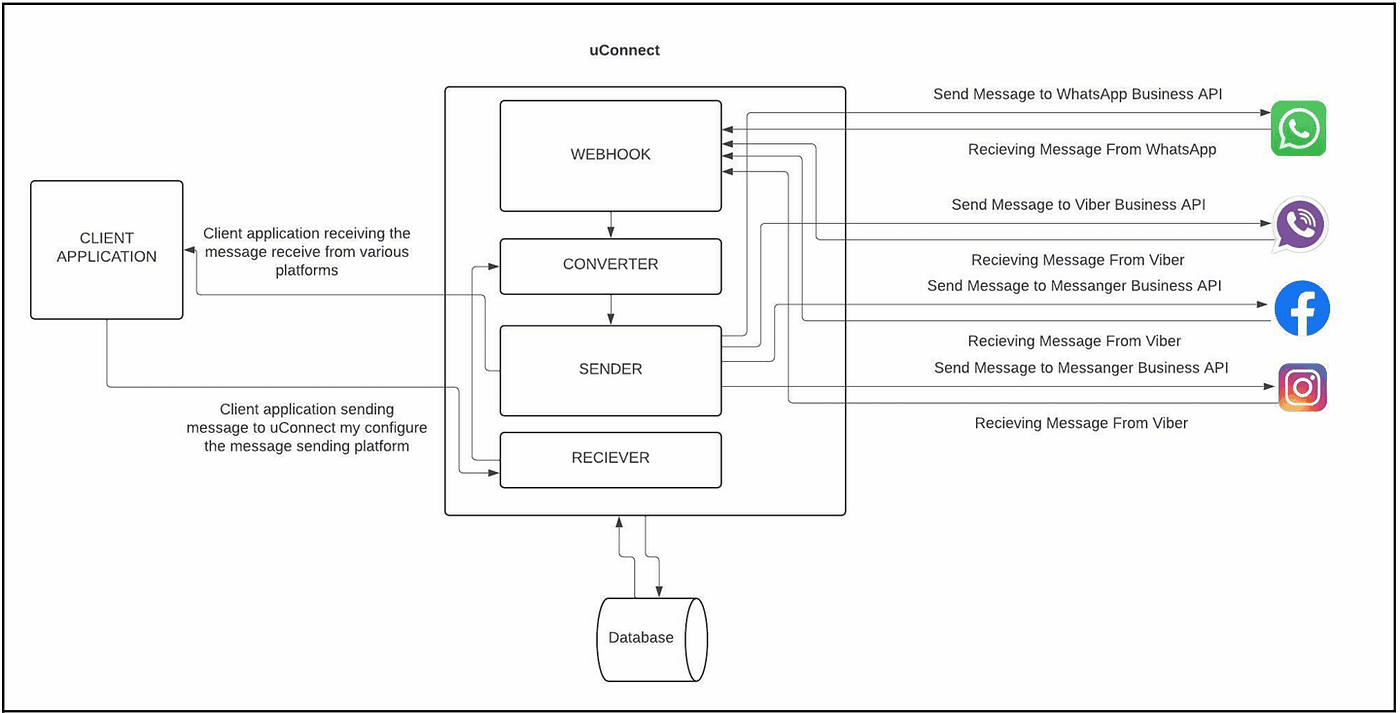
μConnector changes that by acting as a unified bridge, allowing your app to interact with multiple messaging services through a single API. You send a message once, μConnector takes care of converting, routing, and delivering it in the right format for the target platform. It’s like having one language that every messaging app understands.
1async function sendTextToChatPlatform(messageContent) {
2
3    if (messageContent.chatDetails.receiverChannel === 'WHATSAPP') {
4        const whatsappTextMessageObject = await generateWhatsappTextMessageObject(messageContent);
5        return sendMessageToWhatsapp(whatsappTextMessageObject);
6    } else if (messageContent.chatDetails.receiverChannel === 'MESSENGER') {
7        const messengerTextMessageObject = await generateMessengerTextMessageObject(messageContent);
8        return sendMessageToMessenger(messengerTextMessageObject);
9    } else if (messageContent.chatDetails.receiverChannel === 'INSTAGRAM') {
10        const instagramTextMessageObject = await generateInstagramTextMessageObject(messageContent);
11        return sendMessageToInstagram(instagramTextMessageObject);
12    } else {
13        return {
14            status: 400,
15            message: 'Invalid chat platform'
16        }
17    }
18
19}
Built Secure from Day One
Security isn’t just a feature, it’s a foundation. μConnector uses JWT-based authentication, with secure access tokens guarding each endpoint. Only authorized users can send or receive messages. This ensures compliance with data privacy standards and protects communication flows end-to-end.
1async function sendMessageToWhatsapp(whatsappMessageObject) {
2
3    const response = await axios.post(
4        WHATSAPP_SEND_MESSAGE_BASE_URL + '/' + WHATSAPP_API_VERSION + '/' + WHATSAPP_PHONE_NUMBER_ID + '/messages',
5        whatsappMessageObject,
6        {
7            headers: {
8                'Authorization': 'Bearer ' + WHATSAPP_VERIFY_TOKEN,
9                'Content-Type': 'application/json'
10            }
11        }
12    );
13
14    return response;
15}
Real-World Applications
μConnector isn’t just theory; it’s built to solve real problems. Think customer service dashboards, e-commerce notification systems, or marketing automation tools that need to talk to users across multiple messaging platforms. Whether it’s sending a text, a PDF invoice, or even a promotional image, μConnector makes it all uniform.
If you’re building a product that requires chat capabilities across more than one platform, μConnector can literally save weeks of work.
Final Thoughts
Building μConnector taught me not just about backend architecture, but about designing with empathy for developers. We want clean APIs, sensible abstractions, and tools that just work. μConnector is my attempt to provide that in the messy world of messaging integration.
If this sounds like something you’ve been looking for or something you’d like to contribute to, check out the repo, star it, or try it out in your next project.
Questions or ideas? I’d love to hear from you.
Let’s simplify messaging, together.
Originally published on Medium (opens in a new tab).